
News
Conference Report: “AI and Subject-Specific Teaching and Learning: Where Is Foreign Language Pedagogy Headed?”, March 19–20, 2026, Ludwigsburg University of Education
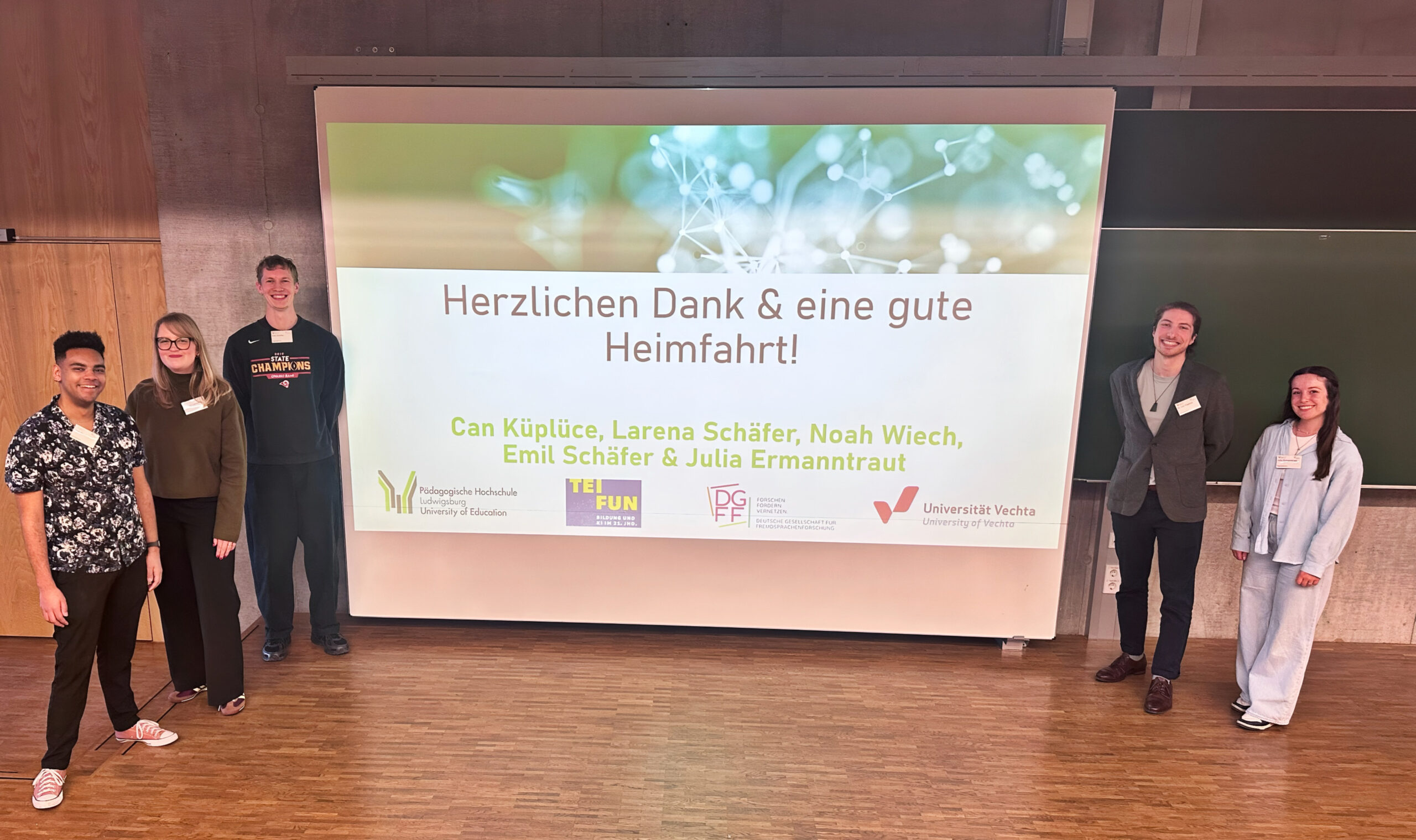
On March 19 and 20, approximately 90 people from academia, schools, and the publishing industry gathered at the Ludwigsburg University of Education to address a fundamental question through 24 presentations, numerous discussions, and two high-profile keynote speeches: “Quo vadis”—where are you headed, foreign language pedagogy?
In her opening keynote, Prof. Dr. Carolyn Blume (Heidelberg University of Education) demonstrated just how many different ways there are to answer this question in light of technological developments in the field of artificial intelligence. She highlighted the implications for research and teaching, but above all for our academic community. The community also served as the conceptual anchor for addressing the question of the path forward. “Like eating pudding with forks,” she concluded in her keynote of the same name, working with AI from a foreign language teaching perspective may be laborious, but it can also trigger a moment that emphasizes ease and shared experience.
In the spirit of community, 24 teams of authors then presented their projects, which covered every aspect of the discipline—from classroom research and university pedagogy to foreign language instruction for professional qualifications. We were particularly delighted by the diversity of the contributions and contributors, who made their way to Ludwigsburg from all parts of Germany and beyond.
Finally, Prof. Dr. Detmar Meurers (IWM Tübingen) reminded everyone that while technological developments are fast-paced, the fundamental principles of (foreign) language learning remain constant. He combined this with a call for the discipline to confidently draw on precisely those principles, identify problems from that starting point, and then find solutions in the field of AI. “Expertise over tech euphoria,” was the plea. A plea that was entirely in keeping with the spirit of the conference, which was designed to focus on the discipline and the academic community. In this way, we sought to highlight what foreign language research can draw from and contribute to the discourse on AI, rather than seeking answers for a technological discourse imposed on the discipline from the outside.
We hope that through this event and the collaboration between the Ludwigsburg University of Education and the University of Vechta, we have taken a step closer to achieving this goal. We would like to extend our sincere thanks to all contributors and look forward to continuing our collaboration. We would also like to thank the Ludwigsburg University of Education, the University of Vechta, the German Society for Foreign Language Research, and the TEIFUN Postdoctoral Research Group for their financial support, as well as WHKs Noah Wiech and Emil Schäfer and SHK Julia Ermanntraut for their excellent collaboration.
Exactly where the discussions and outcomes of the conference will lead will become clear in the coming years through the collaborations that have been initiated and the planned publications. What is already certain, however, is that the path forward will be shaped collectively by the professional community.
Can Küplüce & Larena SchäferDr. Sercan Sever takes up his post
The TEIFUN postdoctoral research group welcomes Dr. Sercan Sever, who took up his postdoctoral position at the Chair of Literature and Media Didactics at the University of Tübingen on 1 July. Dr. Sever's research interests include the use of AI in German lessons, the social consequences of technological innovations and the epistemological connections between language, technology and the future.
Associate membership
It is now possible for postdoctoral researchers with an outstanding doctorate and doctoral candidates whose research work is centered around the topic of "Subject-specific education and AI in the 21st century" and who are not employed as research assistants via the cooperative postdoc college TEIFUN to apply for an association at the college. They can also apply for an association with the TEIFUN postdoctoral research training group. Further information can be found on our website.
13 MARCH 2024 - Launch of Germany's first postdoctoral college for early career researchers with a teaching background
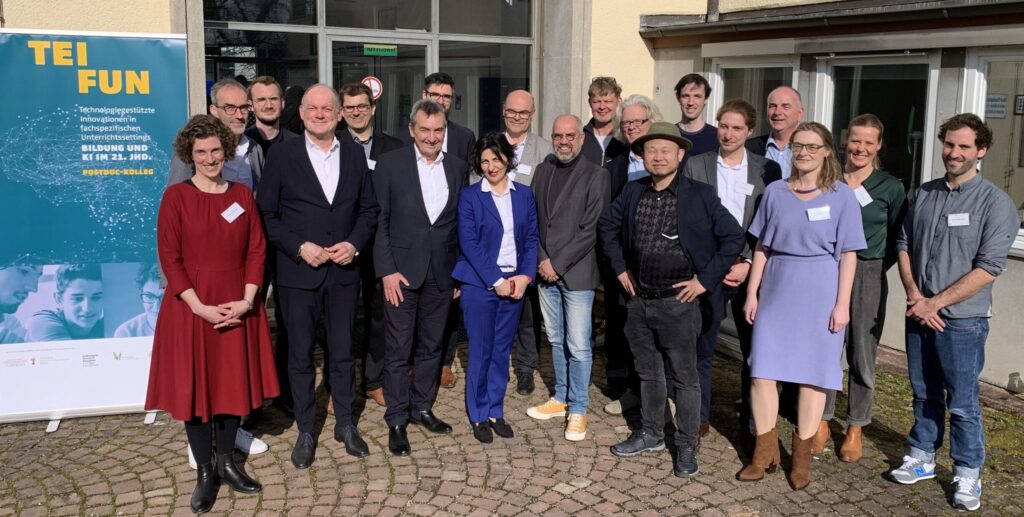
Innovative and practical for high-quality digitally supported subject teaching
Stuttgart/Tübingen, 13.03.2024
Criticism of the slow progress of digitalization in Germany's schools continues unabated. Numerous recent studies have shown that schools in this country have a lot of catching up to do in terms of digital equipment and also with regard to the culture of digitality in teaching and learning. The two Schools of Education in Tübingen and Stuttgart-Ludwigsburg decided that this did not have to remain the case and applied for financial support with their joint concept for a unique postdoctoral college as part of a call for proposals from the Baden-Württemberg Ministry of Science, Research and Arts to evaluate the schools. And they were successful! The first cooperative postdoctoral college in Germany that specifically addresses the needs of early career researchers with a doctorate and practical experience in schools was approved.
The first cohort of the postdoctoral college has now begun its work with TEIFUN, which was officially launched at the beginning of March in the presence of representatives from the respective rectorates and the Ministry of Science at the Professional School of Education's office in Stuttgart. In order to be able to react flexibly to the major challenges of the 21st century in teacher training, the college will change its thematic focus every six years. With its focus on "Technologiegesetützte Innovationen in Fachspezifischen Unterrichtssettings" ("Technology-enhanced innovations in subject-specific teaching settings") - TEIFUN for short - the focus over the next six years will be on the important topic of "Education and AI in the 21st century". At the heart of TEIFUN is the question of how technology-supported innovations can best contribute to an actual improvement in subject-specific teaching. This clearly school-related focus, which the cohorts following TEIFUN will also have, characterizes the college in a special way.
A total of six national and international colleagues have been recruited for the TEIFUN research projects. In their projects, the early career researchers are tackling teaching topics such as writing skills, listening comprehension in foreign language acquisition and the integration of translation software in languages that teachers are not familiar with. The latest technologies such as artificial intelligence and augmented reality are used, the prototypes developed are tested in the classroom and their future use in the classroom is optimized through appropriate research. During their six-year research period, the fellows are expected to complete their habilitation in order to be appointed to professorships in subject didactics or educational science. In this way, the postdoctoral college also makes a decisive contribution to teacher training in the long term.
Ministerial Director Dr. Hans Reiter from the Baden-Württemberg Ministry of Science, Research and Arts, which is permanently funding the cooperative postdoc college as part of the state's academic strategy for the future, Vice-Rector Professor Peter Grathwohl from the University of Tübingen and Rector Professor Jörg Keßler from the Ludwigsburg University of Education gave the college words of support and wished the early career researchers perseverance and success in their ambitious projects.
The Stuttgart director of the college, Professor Christine Sälzer, was pleased to note: "School education is one of the central issues of our time and at the same time a requirement for teacher training. With the cooperative postdoctoral college, a format has been created that creates a long-term academic environment for excellent early career researchers rather than a short-term project, enabling them to develop an academic profile and put their research at the service of teaching development."
Professor Thorsten Bohl, Director of TEIFUN in Tübingen, also expressed his delight at the start of the college: "The profile of the postdoc college and the cross-location cooperation between the participating Schools of Education are unique in Germany. We are also delighted to have six excellent postdocs, whom we were able to recruit in a complex process. After a long period of preparation, we can now finally get started."